Arts Based Research:In Practice
Mary
Arts based research and Poetic Inquiry
I believe that poetry is a powerful form of communication, that it can open a direct line between information (intellectual, emotional, spiritual) and the reader. With such strong and deep potential to connect people with information, it is not surprising that arts based researchers would use poetry to both collect data and represent data. However, there is a huge range of the genres of poetry. In addition, not all researchers are adequate poets. In their paper, (Re)Forming Research Poetry, Lahman et al address these possible pitfalls in a clear way. They collect the data (interviews) and then try four different methods of presentation – traditional prose article, free form poetry, elegy and haiku. What I found really interesting in this work, was that each type of poem revealed both meaning within the research as well as limitations of the poetic form to deliver the meaning. One limitation is that the audience may not be comfortable with the poetic form. They state, “While we would agree and believe that poetry might make research more accessible to an audience, we do not feel this is a given (p. 894). They conclude by saying that, “researchers should use caution in wholeheartedly embracing any one form at the expense of degradation of other forms, including traditional work” (p 894).
As I move through trying to understand arts based research, I find my focus is on the process of gathering and presenting the data. My graduate work is centered on how artists and scientists share common ground when it comes to approaching a problem: there is curiosity, exploration, unknowns and discoveries. Poetic inquiry, as an arts based research method, offers me a way to blend these approaches to problem solving in a way that can reach across and within these two communities. My challenge will be creating a poem that can stand alone.
Skye Poetic Inquiry My search to understand poetic inquiry as a methodology of arts based research started with curiosity and an interest to incorporate poetic inquiry into my visual process. My first connection was with the reading by Norman Denzin, and Laurel Richardson. In that reading she said, “…pleated text to conceptualize the multiple layers of meaning that can emerge in between what is there and what is absent.” I connected this quote to the visual research I was doing with traditional Chinese ink wash paintings that also spoke extensively of the importance of “seeing” both the present and the absence of existence. I created the image presented below by letting a few carefully placed strokes create a whole.
|
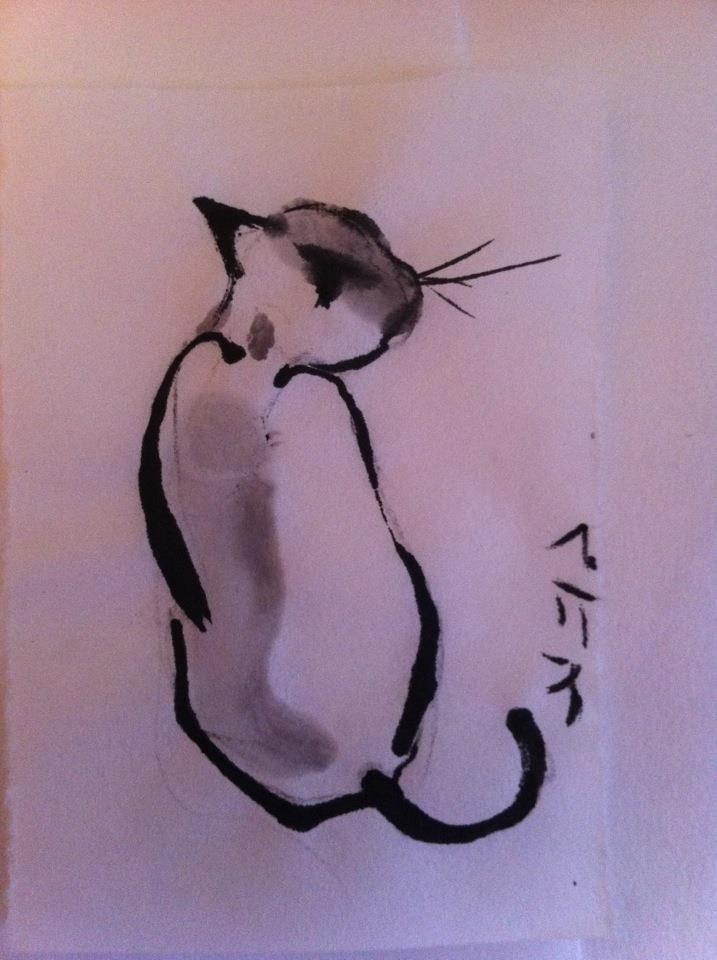
Poetic inquiry as a methodology of arts based research has helped me truly understand the term “meaning-making”. The distillation of information is powerful and holds potential for me in my personally visual process.
Else
Poetic Inquiry
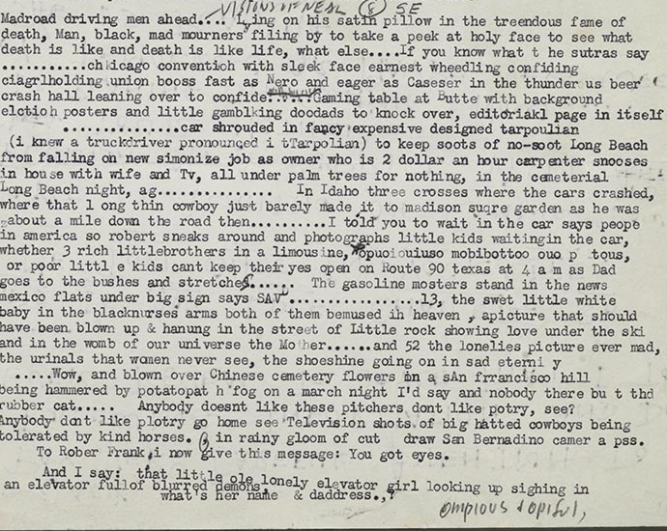
Robert Frank, Swiss, unobtrusive, nice, with that little camera that he raises and snaps with one hand he sucked a sad poem right out of America onto film, taking rank among the tragic poets of the world."
-Jack Kerouac, Introduction to The Americans
Upon reflecting on poetic inquiry and arts-based research I had a sudden 'aha' moment when I remembered my first experience with arts-based ethnography: reading Jack Keroak's introduction to Robert Frank's photographic essay "The Americans." I was developing an interest in photography at the time, and was enamored by Frank's photographs, but it was really Kerouac's word crafted imagery combined with the photographs that stuck with me. I can still remember him wondering 'whether a Jukebox is sadder than a coffin" This was pivotal for me as an aspiring artist and completely turned the direction of my work outward from the studio to the life in the streets that surrounded me. This work falls into that grey area of Arts-Based Research because neither Kerouac nor Frank considered themselves arts-based researchers or ethnographers, but they are bound to and revered by ethnographers for their insight and ways of re-presenting the human experience. I think the following prose by Kerouac both exemplifies the power of poetic verse as well as sums up the relationship between poetry, Frank's photographic art/research, and inquiry into the human experience:
What a poem this is, what poems can be written about this book of pictures someday by some young new writer high by candlelight bending over them describing every gray mysterious detail, the gray film that caught the actual pink juice of human kind. (Kerouac in Frank, 1959 p. 7)
For me, I think of poetic inquiry as another layer to peel off the onion in the research process. It is a layer through which one can delve deeper into data, pull out its essence, rhythm, and soul, and reverberate that in one succinct moment.
Frank, R. 1959, Robert Frank: The Americans, Grove Press, New York (reprint 1997, National Gallery of Art, Washington, SCALO publishers, New York)
Poetry In Action |


